Giovanni Fattori (1825-1908)
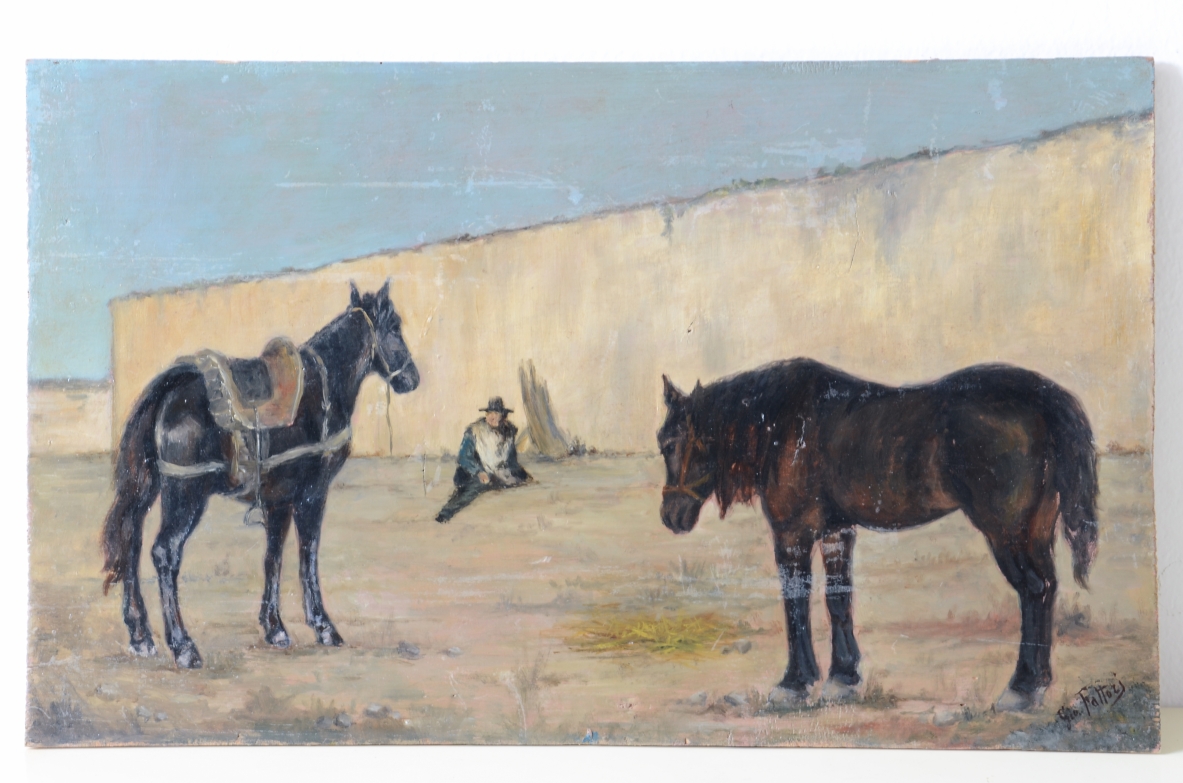
The White Wall.
Oil on panel, circa 1880, signed lower right, Gio Fattori.
The painting depicts a country scene in which a man and two horses stand motionless under the relentless sun of an early summer afternoon. The first horse, placed in the foreground but off-center to the right, abruptly interrupts the horizon line with the wall, presenting a perfect geometry that underpins the entire perspective of the painting. This is the essential motif of the composition, which generally consists of a few other elements, such as the blue sky, the arid ochre plain, and a seated man casting his shadow on the wall (almost as if he wanted to ideally continue its perspective). The composition is supported by a great static quality resulting from the skillful division of volumes and the balance of spaces. In this canvas, Fattori dramatizes the Macchiaioli technique, using patches reduced to the essentials of white, black, and blue, with a few rarefied intermediate tones. The result is a very intense light that, in addition to flooding the entire composition, conveying the image of a scorching summer day, helps to give the scene an undeniable quality of truth, an approach far removed from Romanticism. The suspended atmosphere of this painting, in some ways, almost seems to prelude the dreamlike dimension of metaphysical art, a potentially eternal wait.